
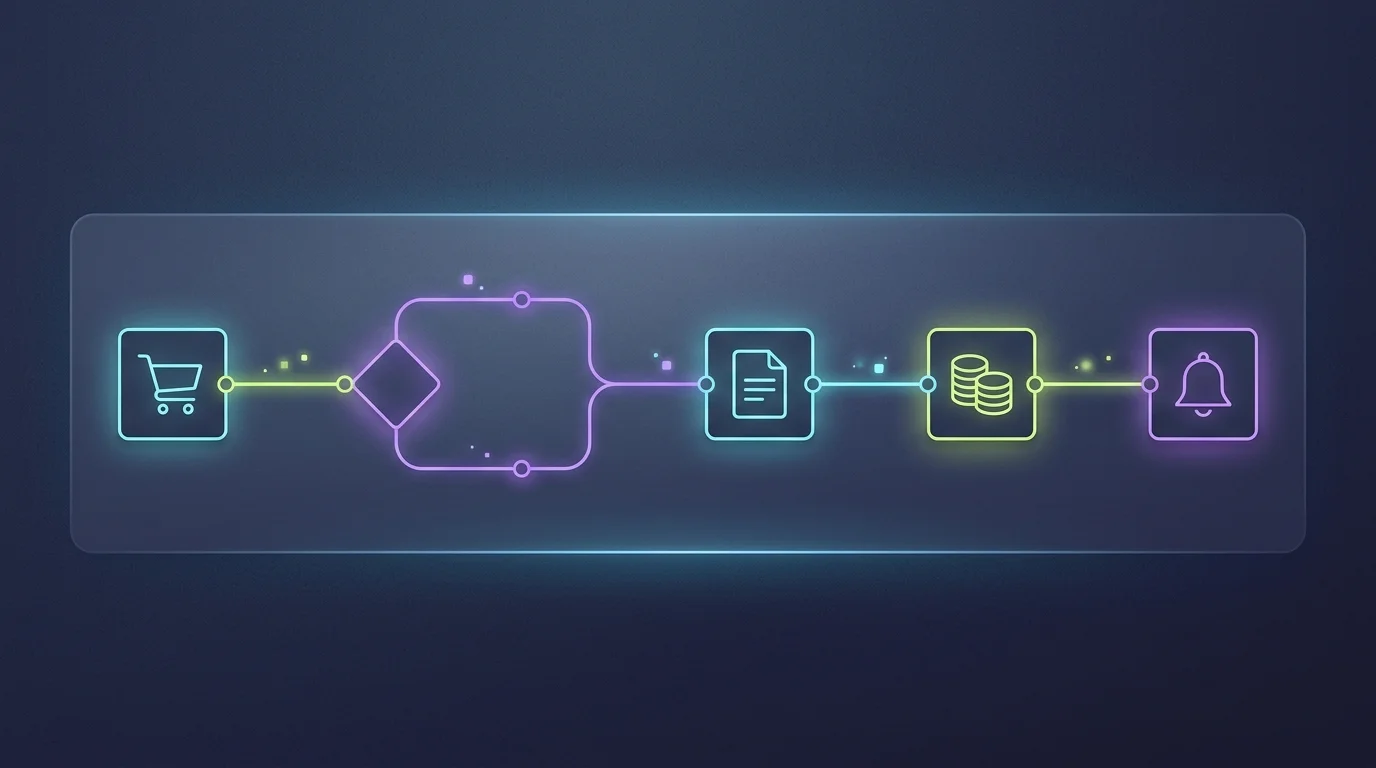
In most mid-market companies, "order to cash" is a relay race run by humans: export from the storefront, check the spreadsheet, re-key into the ERP, email finance, ping the warehouse on Slack. Every handoff is a place where an order can stall silently for days.
On FluidGrids, the whole relay becomes one workflow. A webhook trigger fires when an order lands. Internal nodes shape the payload and branch on business rules — an if node routes high-value orders through a credit check, a switch node fans out by region. Connector nodes do the system work: create the ERP record, generate the invoice, post the Slack update to the fulfillment channel, send the customer email.
Connecting the systems is a one-time act, not a per-workflow chore. Each external service — the storefront, the ERP, Slack, the email provider — gets a workspace connection created once by an admin and referenced everywhere. The workflow definition itself stays free of secrets.
Once activated, the workflow runs in the background on FluidGrids workers, order after order, in parallel when volume spikes. Each run shows every node's input, output, and duration — so "where is order 4187?" is answered by opening its run and seeing exactly which step it's on, not by asking three departments.
When a step fails — a credit API timeout, an expired ERP session — the run records a typed error on the exact node, and after the fix you retry that node alone rather than re-keying the order. The process doc finally matches reality, because the process doc is the thing that executes.
Ready to make this your story?