
Visual Decision Rules
Build a process's decision logic as a versioned tree of conditions, scores and outcomes, and test it against sample inputs.
These images are illustrations of the concept, not screenshots of the actual product.
Overview
Some decisions do not belong inside a workflow step. Who gets approved automatically, what goes to a human reviewer, which cases are declined outright - that logic is reviewed by people who do not read code, changes more often than the process around it, and has to be explainable after the fact. Burying it in a chain of nested conditions on a canvas makes it hard to read and harder to audit.
This concept separates that logic into its own object: a named rule set with its own version history and its own active state, edited as a decision tree. The illustration shows a lending decision as the example. A palette on the left offers the building blocks - a single condition, complex logic that combines conditions with AND and OR, a scoring rule that calculates a value, a decision that defines an outcome or action, and a lookup that fetches data from a source - with a drop area for dragging new blocks onto the canvas.
The tree itself reads top to bottom. A root condition tests a credit score against a threshold and splits, with the comparison written on each edge so the path is legible without opening anything. One side evaluates a debt-to-income condition, calculating a risk score on its passing branch and sending the other straight to review; the other side calculates a risk score at once and branches on the resulting value. Four terminal outcomes close the tree, visually distinguished by kind: an automatic approval, two routes to manual review by an analyst, and an automatic decline.
The right panel is what makes the tree trustworthy. Sample inputs are entered as ordinary numeric fields, a derived field is computed and shown read-only, and a single action evaluates the rule set against them. The result card names the outcome and the score that produced it, reports how long the evaluation took, and links to a trace of the evaluation, so an author can show exactly which branches fired for a given case. A header status marks the rule set as active with a version selector, an export action and a save control, and a resource meter sits in the sidebar.
The design places the rule-set editor inside the workflows area of the product, with the same canvas controls, minimap and versioning cues as the builder. The intent is to keep decision logic readable and testable by the people who own it, while the workflow canvas stays free of deeply nested branching.
What this concept shows
- A named rule set with an active status, a version selector, an export action and explicit save
- A palette of rule blocks: single conditions, AND/OR combinations, scoring rules, outcome decisions and data lookups
- A top-down decision tree where every edge is labeled with the comparison that routes down it
- Scoring blocks that compute a value mid-tree and branch on the result
- Terminal outcome nodes styled by kind - automatic approval, manual review by an analyst, and automatic decline
- A test panel that accepts sample inputs and shows a derived field computed from them
- A result card naming the outcome, the score behind it and the evaluation time
- A link to open the evaluation trace for the tested case, plus a last-tested note and a control to run the test again
How it works
- Open or create a rule set and give it a name, working from the version marked active.
- Drag blocks from the palette to build the tree - conditions, combined logic, scoring rules and lookups.
- Label each branch with the comparison that routes down it and close every path with an outcome block.
- Enter sample inputs in the test panel and let the derived fields compute from them.
- Run the test, read the resulting outcome and score, and open the evaluation trace for that case.
- Adjust thresholds or branches and re-test until the outcomes match policy, then save the new version.
Who it's for
- Risk, credit and compliance analysts who own approval policy
- Operations leads encoding routing and escalation rules
- Automation builders who want decision logic out of the workflow canvas
- Engineers maintaining versioned, testable business rules
Illustrations
1 illustration of this concept. Select one to view it full size.
Rule Set Editor and Test Panel
This illustration shows a rule-set editor for a lending decision. The header names the rule set, marks it active, offers a version selector, an export action and a save control. On the left, a palette lists rule blocks with one-line descriptions: a single condition, complex logic combining conditions with AND and OR, a scoring rule, an outcome decision, and a lookup against a data source, above a drop area for adding blocks. The canvas holds a top-down tree: a root condition on credit score splits on a threshold, one side testing debt-to-income and scoring risk on its passing branch, the other calculating a risk score directly, with each edge labeled by its comparison. Four terminal outcomes close the tree - an automatic approval, two manual-review routes and an automatic decline. The right panel takes sample numeric inputs, shows a computed field, and returns a result card with the outcome, score and evaluation time plus a trace link. All values are sample data.
Topics
- visual rule builder
- decision tree editor
- business rules engine
- approval routing rules
- scoring rule builder
- test rules with sample input
- rule evaluation trace
- versioned rule set
- automated approval and manual review
- no-code decision logic
Related concepts
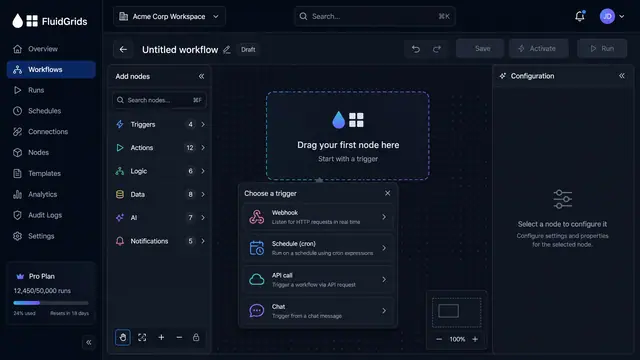
Visual Workflow Builder
Draw an automation on a canvas - trigger, branches, connectors and merges - then watch a test run light the same picture up step by step.
4 illustrations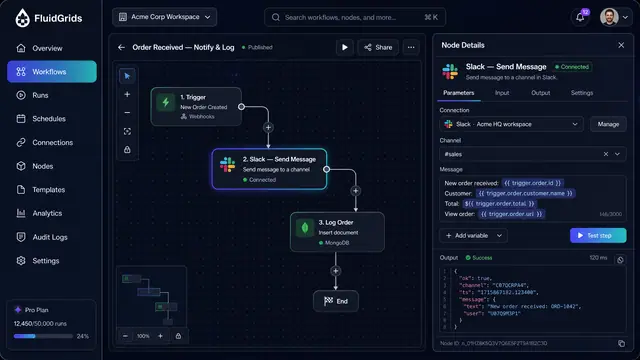
Node Configuration, Data Mapping and Code
Configure a step against a saved connection, map fields between services by dragging lines, and drop into sandboxed code when needed.
3 illustrations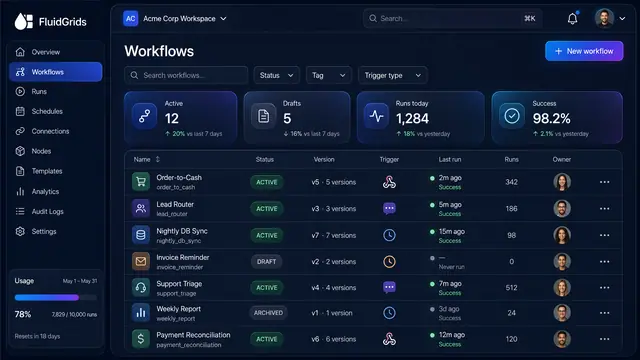
Workflow Library, Versions and Publishing
Track every workflow's status and version, compare and restore past versions, and publish with a pre-flight check that arms triggers.
3 illustrations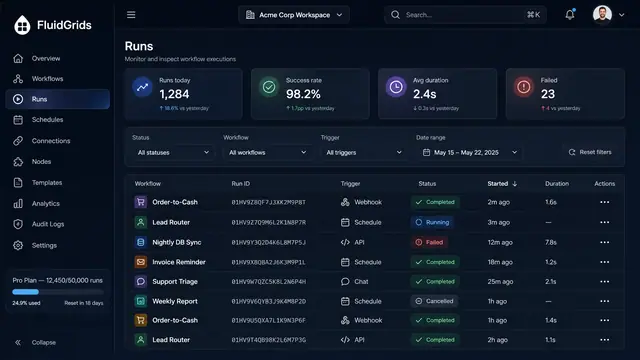
Run History, Inspection and Recovery
Follow every workflow execution node by node, then retry, resume or approve runs from a desktop or a phone.
5 illustrations